Water (H2O) makes up more than half of our body, it is present in sound composition, ranking in the top 10 of the most commonly used concrete sounds, but above all it makes this column damp.
It is said to cover 71% of the Earth's surface, and it has also crept into the air, underground and inside every organism. In nature it can be found in a gaseous, liquid and solid state.
We are therefore perpetually damp, we slip into a drop of water that carries both science and culture with it, while we fear the day it might run out. Water invites us to act.
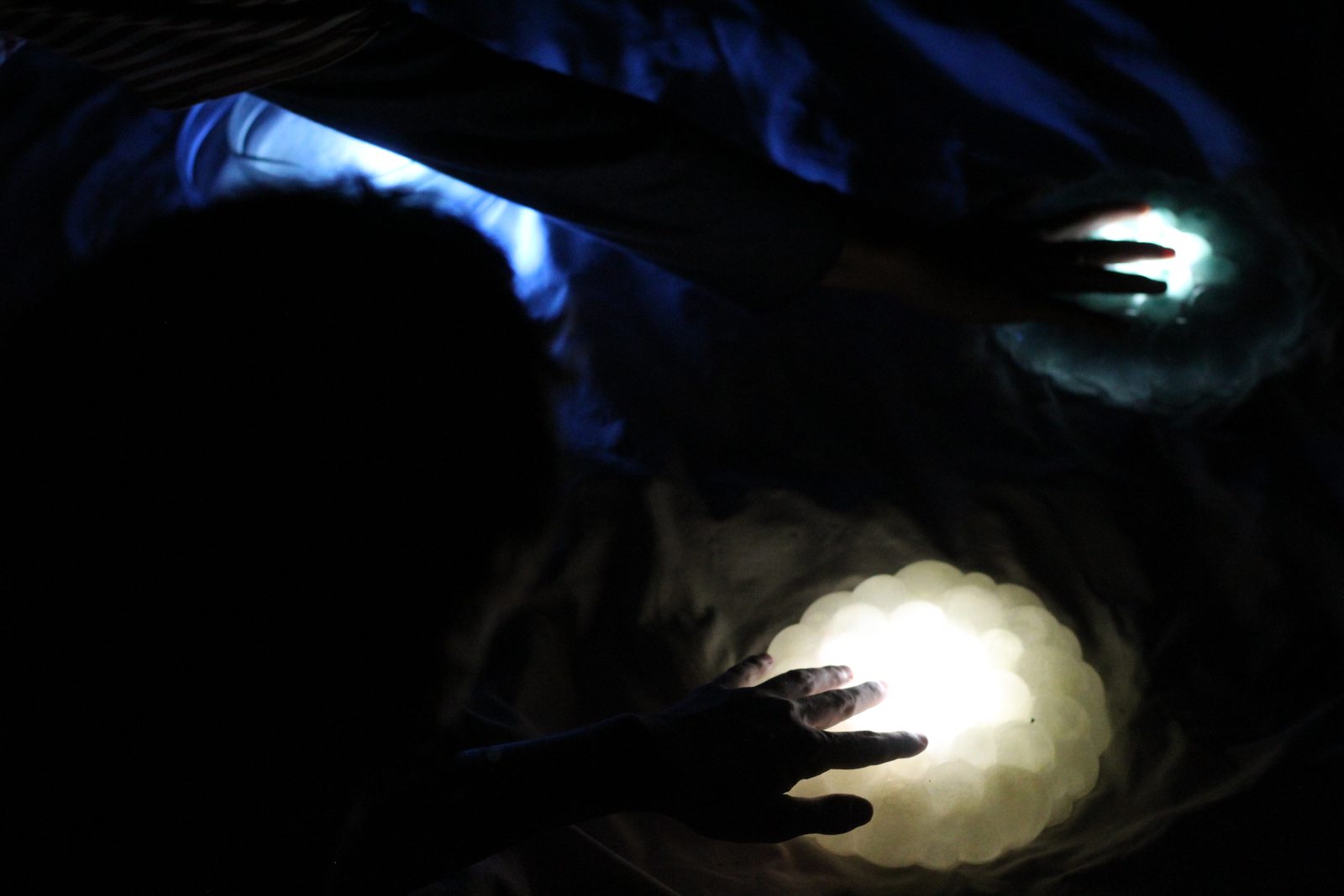
During this hot summer I had the pleasure of hosting, for an event, Chiara Pitrola with her project Tracecorporeal: “a continuous series of hydration liturgies and ephemeral participatory installations”.
An adventure that had us cooling off around a bonfire of ice, sipping freshly brewed herbal teas and listening to an immersive soundscape.
I would therefore like to offer you a short interview with Chiara, talking about water, sound and fluidity.
Hi, thank you for sharing your practices with us during the event held in August, organized by Biodiversità, Ambient Noise Session and Denso. And thank you for being here between the lines of Golem. I invite you to introduce yourself and give a brief overview of your work.
Hi, it was a pleasure to end the summer with you; a space of sharing this intimate doesn't always come about, and I felt at home, above all in terms of sound (perhaps some would agree that a DJ set can be a home, just as a playlist can be something to inhabit). For some time now I have identified as a hydrofeminist practitioner: my research has evolved into a series of embodied hydrofeminist iterations in which audience participation is fundamental.
Could you introduce us to “Trancecorporeal”?
For me, Trancecorporeal is performing with water (and the messages, minerals, bacteria, pollutants, nutrients it carries); it is a sonic experience (the soundscape Be Foam, Be Soup, narrated by a tide, circumscribes atmosphere and imaginary), a sensory one (ice shapes, tea, essential oils), a performative one (tea preparation, boiling water, vapors). My aim is to translate the complexity of the hydrofeminist imaginative tools proposed by Astrida Neimanis into something that can be experienced at various sensory levels and is accessible to everyone. Transcorporeality, a concept coined by Stacy Alaimo that inspires the title, refers to the transits of human and non-human bodies. The latter, together with the concept of posthuman gestationality (a facilitative logic of gestating new forms of life through bodily waters, never fully knowable), lays the foundations for a collective memoir, since we have been interconnected bodies of water since antiquity, for better and for worse. T. hopes to lubricate our perception of these often invisible transits, and to lay the groundwork for tuning in to the collective multispecies artery in which we are immersed, stripping away conceptions of water as a resource, a commodity, a fetish to be instrumentalized.
The version of Trancecorporeal I attended was a little different from past sessions. The space was open, in the midst of nature, and several layers formed: those who watched from afar, those who followed attentively while seated, those who gathered around the central ice bonfire. Not everyone touched the ice, others abused it, some entered a more meditative state and others a more convivial one, sharing the herbal teas you offered. Finally, we were all captured together by the last plays of light until the end of the performance.
What is your relationship with the audience, and how much can the experience change depending on the many variables that can come into play?
The experience changes completely depending on the space, the lighting conditions, the audience and even the temperature. My relationship with the audience is, I think, mainly one of listening; I am learning to improvise adjustments in reaction to the audience, but also to push the bulk of my presence and gestures further if I feel that a certain level of openness and intimacy has been triggered. It is a dance with fluctuating trends in personal and collective disinhibition, a precious unknown.
Trancecorporeal is also hydrofeminism; could you explain the hydro and the feminism for us? Are we also talking about activism?
The core of the imaginary is precisely water, and how the politics (of positioning), poetics and temporalities linked to it provide a critical space to reflect on corporeality in an intersectional way. Ecology, bodily fluids such as sweat and amniotic fluid, rave studies, sound, spoken word and pleasure activism are themes I am currently interested in and working on at a theoretical and somatic level. For me, imaginative work and ecological awareness of the body, as well as forms of resistance linked to rest and pleasure in neocolonial and patriarchal late capitalism, are forms of activism.
The experience is enriched by a sound component; I noticed there are moments and synchronies with the proposed action, but I also think the piece could be an autonomous work. I found variations of mood and attunement across its various moments. Could you tell us how the piece was made, both technically and emotionally?
“Be foam, Be soup” was born from a simultaneous interest in verbality as incantation and sonic non-verbality as re-enchantment. It started as a shorter spoken narrative inspired by hydrofeminism, transcorporeality, the visibility and invisibility of bodily transits. It evolves as a soundscape with incursions of images linked to my grandmothers' herbal practices and to speculative formulas on how to become a pearl. The atmospheres oscillate from the dark, to the playful, to the meditative, to the hallucinatory erotic, drawing on the mating ritual of horseshoe crabs in the intertidal zone (interrupted by extractivist technoscientific procedures that remove them from their habitat), on primordial broths and underwater explorations.
One of the most fascinating things about water is the deep abysses, where those organisms that managed to escape the sight of humans still live. Water hides many things, and something new is always discovered... Do you want to find something on the seabed?
If I could choose to have other physical characteristics, I would definitely choose gills and antennae. I hope to re-enter, mentally and imaginatively, the depths of the ocean as Rachel Carson describes in “The Sea Around Us” (1951) and to develop a language of underwater bubbles with nonbinary many-headed creatures, wandering about echolocating my extended marine family.
In music there are many works linked to water, and it might be redundant to ask you for an album or a themed listen. So I would like to ask you to share some music that melts you, that takes you from the solid state to the liquid one.
Nimiia vibié by Jenna Sutela, which, between Martian languages and extremophile space bacteria, does a work halfway between a séance and microscopic scales that dissolves the boundaries between bacterium, the Western mind-body split, and language.
English translation of the Italian original. Read the original →