Building something together requires that we talk to one another, and that we listen. It is not a matter of subscribing to an idea or of a founding act: it is a practice that has to be repeated, as one does with important things. It starts from the voice, but does not end there: it needs someone willing to lend an ear. Speaking and listening never happen together, at the same moment and in the same place. Between the two there is always a space to cross — of time, of distance, of differences — without which we never truly meet.
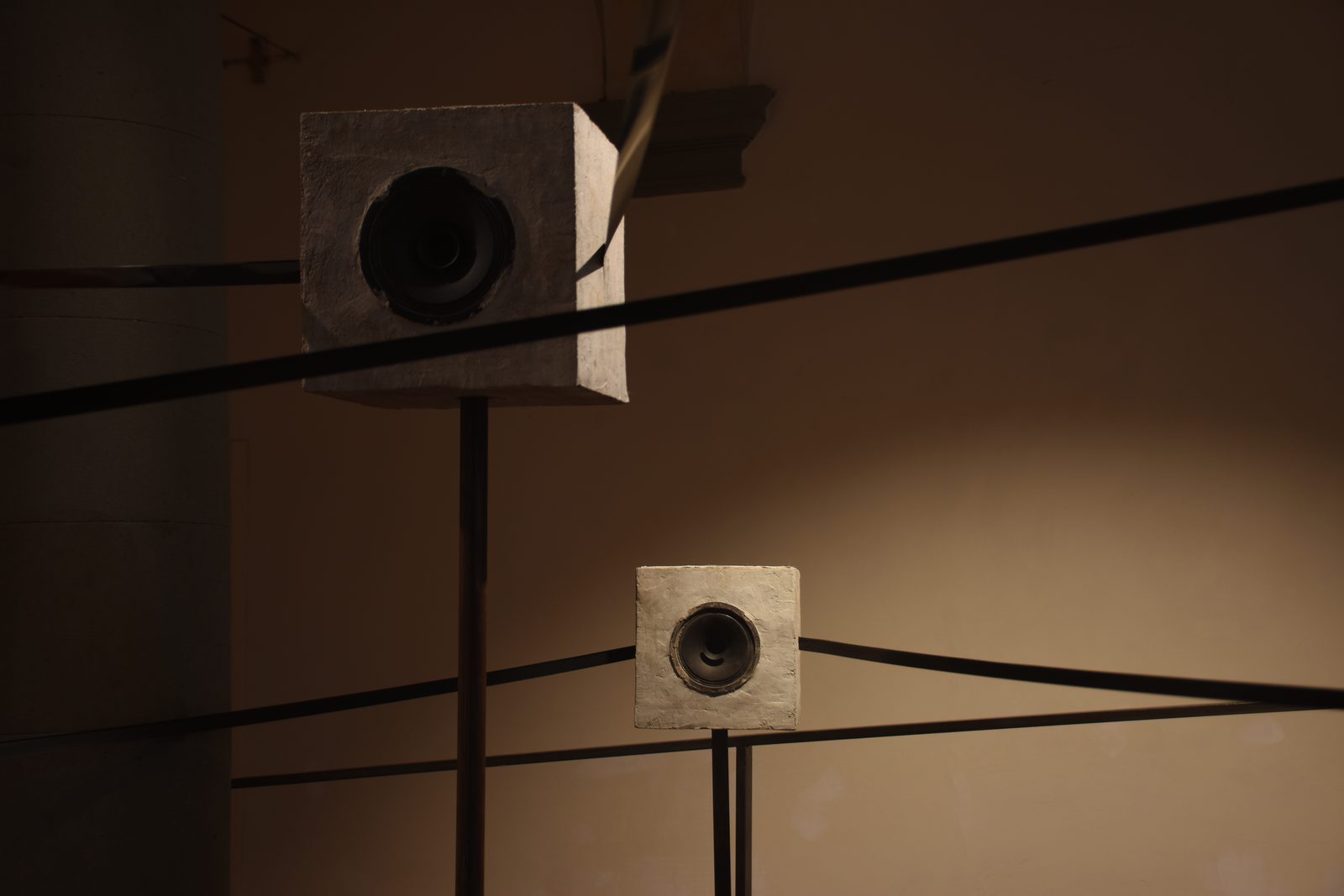
Keep it Alive makes this space visible and allows us to traverse it. The magnetic tape that runs between the modules represents precisely that distance that separates the one who speaks from the one who listens: it does not hide it, it makes it tangible, ensuring that these parts remain in constant dialogue.
The modules are built of concrete, iron, brick — construction-site materials. Raw materials that carry in their pores the dust of places in transformation, that remind us how building something that lasts requires time, patience, and many hands working together. In the exhibition space they take on a suspended form, neither building nor ruin, evoking work just begun or momentarily halted. Without the tape that connects them, they remain separate elements. It is the recorded voice that turns these objects into a common place. It is the same condition as any group trying to build together: a work that never concludes, that demands constant presence and care for detail, because what is erected too quickly hardly holds.
The sonic landscape of the installation lives and breathes with the people who inhabit it. It changes with every new voice, with the time that passes between one intervention and the next. When someone speaks into the recording module, the sound begins its journey through the space: it is carried along by the tape, passes through the playback modules, is amplified and returned to the environment. But with each cycle it loses something — a fragment of clarity, a nuance, the precision of what had been said. The message keeps circulating, but it transforms, becoming other than itself.
This progressive transformation, which might appear to be a flaw in the system, is instead its conceptual heart. The process recalls Alvin Lucier's research in "I Am Sitting in a Room," where the repeated regeneration of sound through space turned the human voice into pure environmental resonance, revealing the physicality of sound itself. Pellegrino takes up this theme but steers it in a different direction: here degradation describes concretely what happens to meaning when it is not continually renewed — when voices thin out, when listening fades. Sound does not vanish suddenly: it is gradually consumed, becomes noise, loses the form it had when someone gave it voice. What remains persists in the space, but no longer communicates, becoming the trace of a communication that is no longer nourished. The tapes that join the modules turn the installation into a relational device: their continuous flow not only carries sounds, but makes visible and tangible the very bond between those who speak and those who listen, showing how that bond corrodes when constant exchange is missing.
The tapes thus become sonic archaeologies in the making, media that carry not only sounds through space but above all memories through time. Each added voice dialogues with the preceding ones, creating involuntary polyphonies among communities of different moments. The voices do not overlap randomly, but create a dialogue between absences and presences, between those who have been here and those who are here now. The transformation operates as a democratic process: all voices, regardless of their original content, undergo the same mutation into pure sonic presence.
The tapes are never reset. What remains imprinted on them is the sonic trace of this very place: the voices of those who live it, of the community that inhabits it at this moment. With each new installation this memory returns to the space as a background layer, on which the present voices settle. When no one speaks, there is no absence but the presence of background noise: it is the collective breath, the sonic trace of the community that has been here, the sonic lung that keeps the dialogue alive even in silence. An accumulation that is constantly consumed and renewed.
The sense of being together is built continuously, or it dissolves. Keep it Alive reminds us that communities, like sounds, live on mutual listening and continuous care — otherwise, slowly, they become the echo of what they might have been. It is the sonic breath of a community that builds and transforms itself over time, a vital circulation of voices that asks only to be kept alive.
English translation of the Italian original. Read the original →